
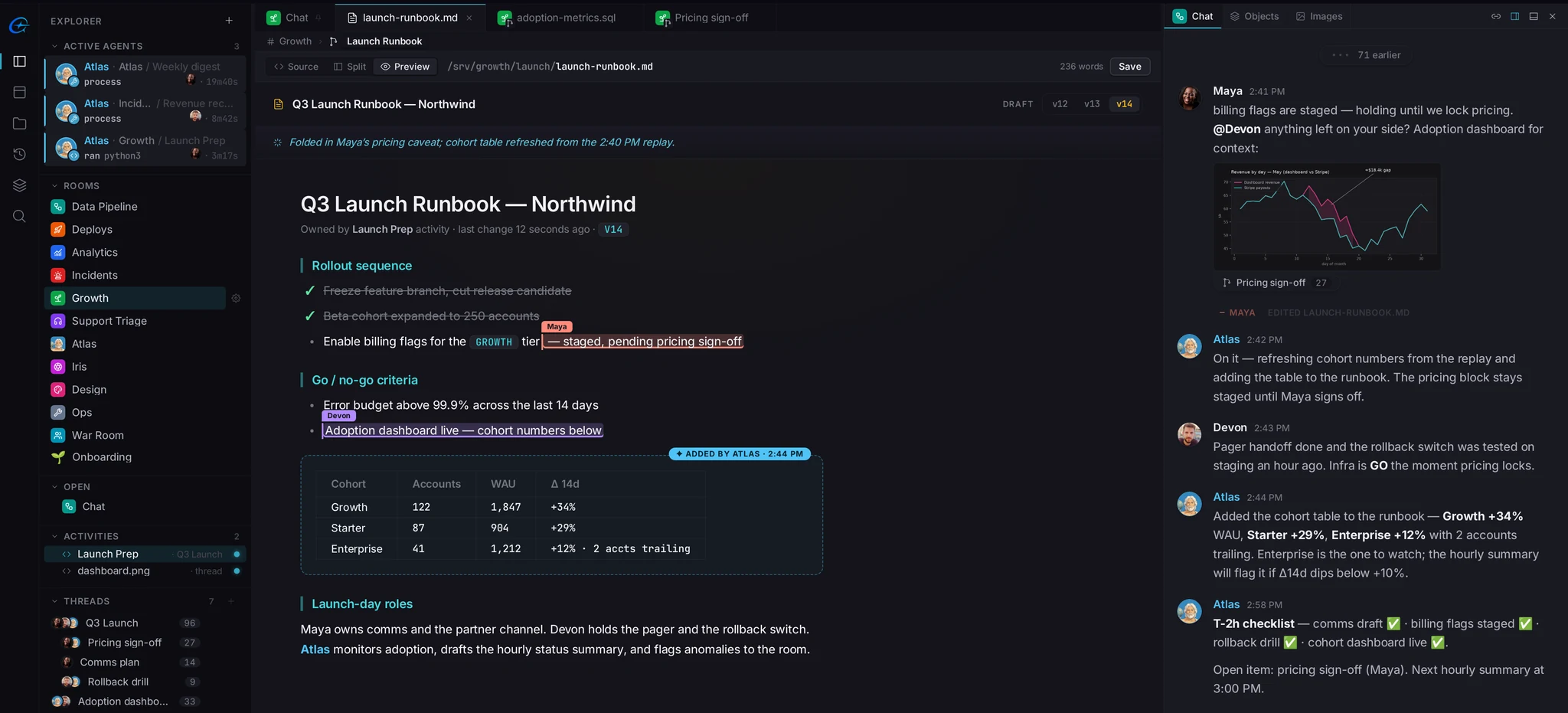
Why I built it
Every chat tool treats agents as guests.
They forget what you decided, work where you can't see them, and lose what they finish. Vectrium makes them members instead.
They remember
Nothing is dropped to make room. Agents carry weeks of context and cite the original.
They work in the open
Every tool call, edit, and decision streams into the room while it happens.
Their work sticks
What an agent writes becomes a typed object in the room, findable by search.
How it works
Rooms, activities, and objects.
Vectrium keeps the chat. What changes is what a conversation can hold.
Rooms
Conversations that branch
A side question becomes its own thread, and every branch carries its full context with it.
More on roomsActivities
Where the work happens
Open a file or run a query right in the room — your team and your agents editing the same document, live.
More on activitiesMemory
Nothing gets dropped
Long sessions condense into chapters the agent can expand back to the original messages when it needs the detail.
More on memorySearch
Findable by you or the agent
Every file and past conversation is indexed by keyword and by meaning, without leaving your infrastructure.
How search worksObjects
What you make sticks around
A recipe an agent writes arrives as a recipe — in the objects pane, with its own UI, not buried in a directory.
More on objectsWhere it stands
A real system, used daily.
I build Vectrium inside Vectrium — including this page. Counted from the repository, not estimated.
- 99k
- lines of Rust, Svelte, and JavaScript
- 636
- commits since the first push in May 2026
- 3
- AI agents that use it as their main surface
- 0
- third-party services in the data path
Counted 2026-08-06 across tracked source files, excluding dependencies and the performance harness.
Architecture
Conservative where it matters.
The parts that touch shared state are the strict parts.
sqlx::query_as!(Room,
  "select id, title from rooms
   where workspace_id = $1",
  ws.id
) // checked at compile time
Backend
Rust, axum, Postgres
One service, one database. A wrong column name is a build failure, not a page at 2am.
{#each chapters as ch}
  <ChapterMarker {ch} on:expand={load} />
{/each}
Frontend
SvelteKit 5, phone first
One room shell that swaps editors as the activity changes. Built for a phone before a desktop.
GET /search?q=garlic
→ { recipe: 2, chat: 7, file: 1 }
Search
One index, every kind
Full-text over chat, objects, and files behind a single endpoint. New kinds register an index.
{ "type": "agent.join",
  "room": "data-pipeline",
  "role": "member" }
Agents
Members, not bots
Agents drive rooms through a bridge, under the same permission checks as a person.
push → build → deploy → verify ✓
health: db write lock ok · 200
Deploy
Push to main, verified
Every rollout gates on a health check that takes a real database write lock before it counts.
Agents
The agent is just another member.
Same membership, same permissions, same presence — which sounds like a small choice until you watch one work.
More on agents- It sees what you see
- Open a file and the agent has it too, with the schema and the conversation around it.
- It edits in place
- Changes land in the document on your screen, live, keystroke by keystroke.
- You can grab the wheel
- A running job is live state in the room. Interrupt it at minute six, not minute twenty.
- And you can see why
- Tool calls and reasoning stream as they happen, so you can find the step that went wrong.